
Laser-Focused On Pickleball Performance
Pickleball players are obsessed with getting better. After every game, they search for signals in the noise—game results, DUPR changes, feedback from partners and opponents, coaching advice, and sometimes video or match statistics.
Most rating systems are designed to answer one question: how good is this player?
A true performance model should also answer a harder, more important question:
what actually drove winning and losing?
But in pickleball—played primarily as doubles—isolating individual performance is inherently difficult.
Modern sports analytics solves this by anchoring player value to the objective of each player’s actions in the sport.
In pickleball, every shot has one purpose: to change the probability of winning the rally.
A Rating for Every Part of Your Pickleball Game
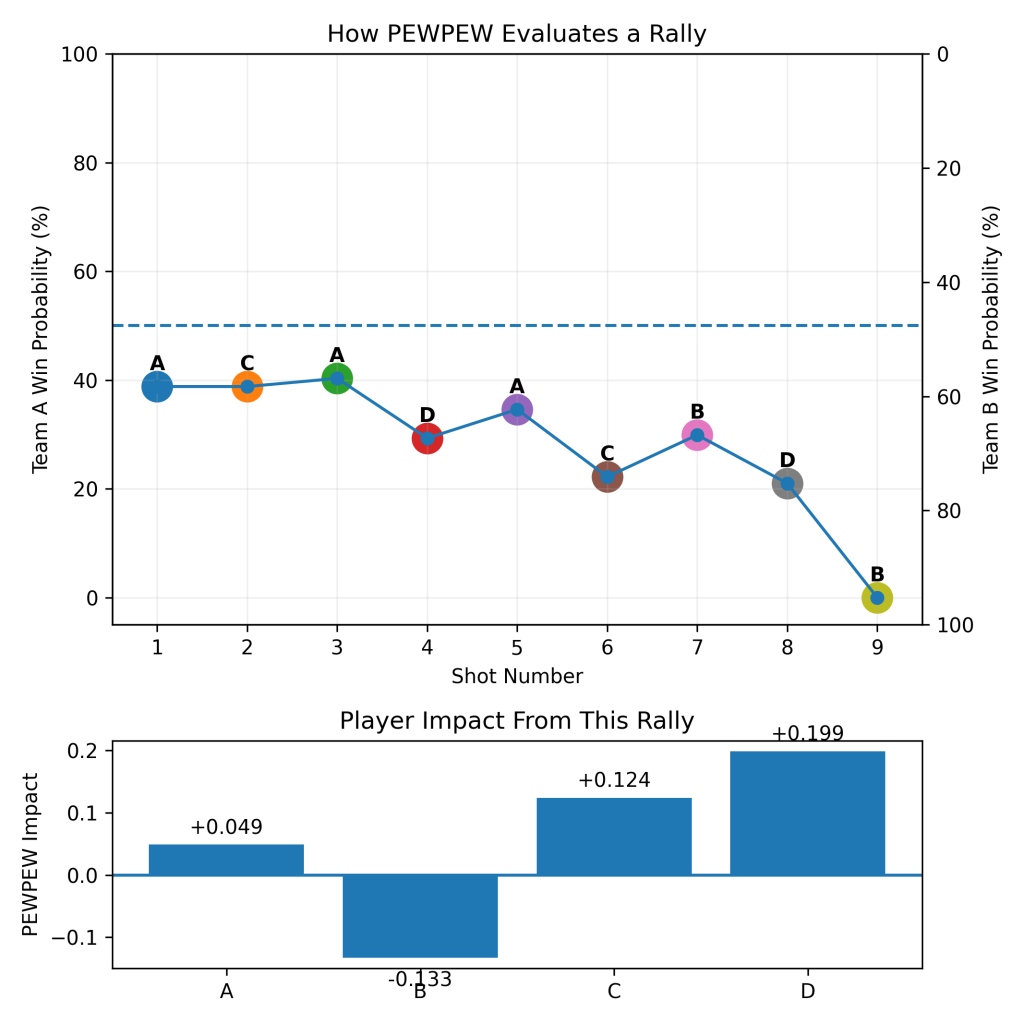
PEWPEW measures performance by evaluating how each shot changes a team’s chances of winning the rally. Using shot-level match data generated from video, the system estimates the impact of every shot.
This produces reporting on a familiar DUPR-like scale that delivers accurate player ratings—and, more importantly, explains why matches were won or lost and each player’s impact on the result.
Because the model is built from the ground up—at the shot level—those same ratings and impact metrics can be broken down across any part of a player’s game, from serves and returns to third-shot drops, baseline drives, and left- or right-side kitchen play.
The result: a complete view of a player’s impact—trackable over time, AI-ready, and grounded in what actually drives winning and losing.
What Is PEWPEW?
PEWPEW (Player Estimated Win Probability Effect With Shots) is an analytics framework that measures the value of every shot in a pickleball match.
Using video-derived shot-level data, it evaluates how each shot changes a team’s chances of winning the rally and aggregates those effects into player impact metrics and DUPR-like ratings across different parts of the game.
Because the model is grounded in rally outcomes, it provides a consistent way to measure how players actually influence match results—not just how they play, but how they drive winning and losing.
The result is a structured, AI-ready layer of performance data that powers match reports, player ratings, and clear explanations of match outcomes and player strengths and weaknesses.
Answering The Key Questions Every Player Asks
PEWPEW turns shot-level match data into performance dashboards, match reports, and outcome-based ratings that answer the questions players ask after every match—while providing structured metrics that enable AI systems to generate clear explanations of match outcomes and player strengths and weaknesses.

Why Did I Win or Lose?
Quantify the factors that actually drove the result—showing how different shots and situations contributed to victory or defeat.

What Are My Strengths / Weaknesses?
See DUPR-like ratings across every part of your game, revealing where you create (or lose) value on the court.

How Did I Actually Play?
Measure your true impact on each point—separating your performance from partners and opponents.

Am I Getting Better?
Track performance over time to see where your game is improving—and where it still needs work.
Every Shot Needs A Target
The one statistical truth in a doubles pickleball match is the final score. Any model that evaluates player performance must ultimately be grounded in that reality. If it cannot explain why one team won and the other lost, it’s difficult to trust that it reflects true player value.
Rating systems like DUPR reflect this principle—they are designed to predict future match outcomes based on past results.
But in pickleball, many different playing styles can produce the same rating. Players reach the same level through different combinations of strengths and weaknesses.
To understand how those skills translate into results, the game must be measured where outcomes are decided: each individual shot.
PEWPEW does exactly that—quantifying how every shot changes a team’s probability of winning the rally and translating those effects into player ratings and performance insights grounded in two things every pickleball player understands: winning and ratings.
Analytics First. AI Amplified.
Generative AI has fundamentally changed how players can interact with performance data.
Players can ask questions like:
- Why am I losing games?
- What should I work on first?
- Is my backhand really weaker than my forehand?
- How has my game changed over time?
and receive immediate, personalized answers.
The challenge is that AI is only as useful as the information it receives.
Some systems ask AI to interpret raw match data directly. Others attempt to move from video and computer vision straight to coaching recommendations.
In both cases, the underlying logic for what matters most can become difficult to validate or explain.
For players who care about improving, trust matters.
If a player wins the most games, wins the most rallies, and consistently impacts results—but the analytics rank them last—confidence in the system quickly erodes. Players may not understand every detail of the methodology, but they intuitively understand when conclusions conflict with what happened on the court.
PEWPEW takes a different approach.
Before AI enters the process, match data is transformed into structured performance data using a transparent analytical framework that evaluates how each shot changes a team’s probability of winning the rally.
The result is structured, outcome-driven performance data that AI can explain, summarize, and explore.
Rather than asking AI to determine what matters, PEWPEW provides a foundation grounded in what actually drove winning and losing.
This creates the best of both worlds:
- Analytics that are transparent and accountable
- AI that is personalized, conversational, and easy to use
When insights are built on a consistent analytical foundation, they are far more likely to pass the “sniff test” for players and coaches who know their own games.
As video-derived performance data becomes increasingly connected to player ratings, coaching tools, and smart-court platforms, that analytical foundation becomes even more important.
Improving performance starts with trustworthy measurement.
AI becomes dramatically more powerful when built on top of it.
Where PEWPEW Fits
PEWPEW Analytics complements the growing ecosystem of video and smart-court technology in pickleball. As platforms capture match footage and generate shot-level data, a new foundation for the sport is emerging.
PEWPEW extends that foundation—turning shot-level data into outcome-driven performance analytics that explain results, quantify player impact, and generate DUPR-like ratings across every part of the game.
For video and smart-court platforms, this creates several advantages:
Deeper performance insights and AI-driven analysis
Explain why matches were won or lost and quantify each player’s impact—while enabling AI systems to generate clear, trustworthy summaries
Greater value from video and shot-tracking data
Transform raw shot data into performance dashboards and match reports that go far beyond surface-level statistics.
Focus on core technology and user experience
Continue advancing capture, computer vision, and UX without needing to build and maintain complex analytics models.
New premium analytics and coaching features
Unlock advanced insights and gameplay ratings that support subscriptions, coaching tools, and deeper player engagement.
Natural alignment with rating systems like DUPR
Outcome-driven metrics provide a clear bridge between video-derived insights and broader rating ecosystems.
Built to Integrate with Video Platforms
PEWPEW is designed to operate at enterprise scale, enabling video platforms to generate advanced performance analytics within seconds after a match ends.
The system integrates with existing video and smart-court platforms through a simple API—accepting shot-level match data and transforming it into outcome-based analytics without requiring changes to capture or AI pipelines.

1. Video Platform Captures Match Data
Video systems record matches and generate shot-level data, including player actions, ball trajectories, and rally sequences.

2. Shot data Sent To The PEWPEW API
Match data is processed to evaluate how each shot influences the probability of winning the rally.

3. Analytics Returned To The Platform
• Match summaries with individualized player impact metrics
• Structured outputs for dashboards, reports, and AI-generated analysis
• Gameplay ratings and player trends across matches
Contact Us
Ready to add performance analytics your players will obsess over?
PEWPEW Analytics is currently seeking video technology and club partners. Reach out to schedule a demo or discuss potential integrations.
You can also e-mail directly at info@pewpewanalytics.com